
The vanished inns and cafés of Tokaj: where wine deals were once made
In search of Arany Sas, Fekete Sas, Rákóczi Inn, and a café wine exchange
This August, the Arany Sas reopened in the main square of Tokaj. After more than eight decades, the building once again welcomes guests: it houses a café, garden, and event venue, with concerts from the Zemplén Festival taking place in the upstairs room on the first evenings. Those who entered may not have thought that in the same building, harvest balls were once held, a casino and fencing club operated, and the players of the Tokaj wine trade also met in the café.
When we think of Tokaj, we mostly recall the cellars, the vineyards, and the aszú. The city's old inns and cafés are mentioned far less frequently, yet they were not only part of the history of wine trade along with the barrels and cellars. The buyer and seller had to meet somewhere to discuss prices, the harvest, and transportation. These meetings were also important venues for inns and cafés. Some of our knowledge about them is preserved in the city monograph titled Tokaj and its surroundings published in 1930, contemporary advertisements, and local historical research.
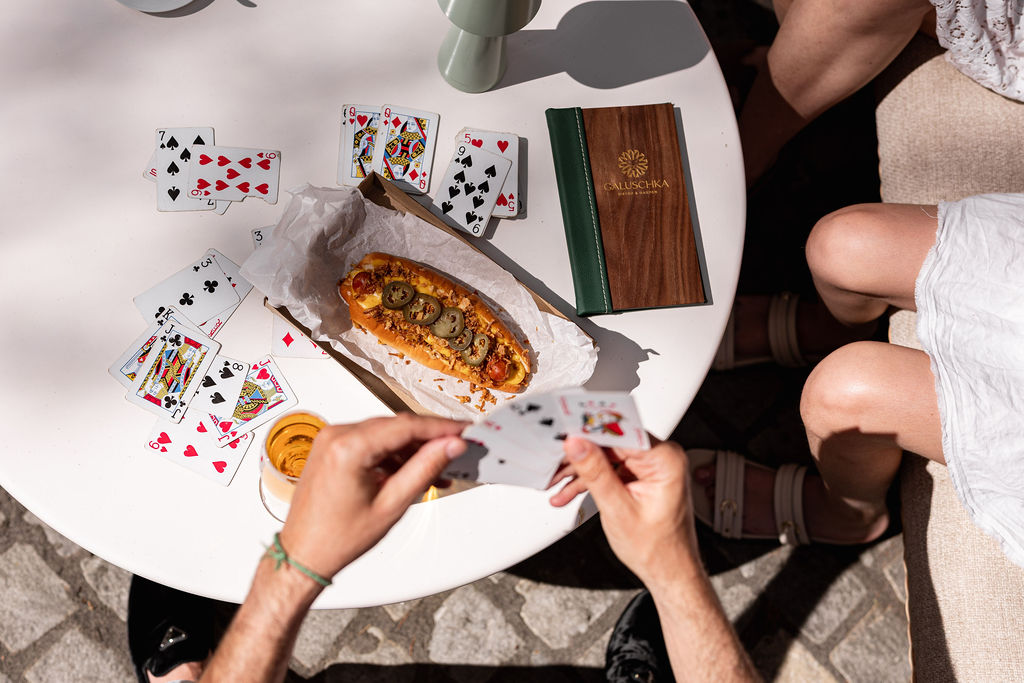
Where people still converse over wine today.
Galuschka Bistro & Garden · Tokaj
Tables of a trading city
Tokaj lies at the confluence of the Bodrog and Tisza rivers and has been one of the centers of the wine trade in the Tokaj region for centuries. From here, wine headed north to Poland and Russia, while goods and people arrived via the rivers. Merchants, agents, carriers, and officials frequented the city. They needed accommodation, meals, and places where they could build connections, obtain information, and find future business partners.
Some settled in for a longer period. Between 1733 and 1798, the Russian imperial court operated a permanent wine purchasing committee in Tokaj to ensure that aszú regularly reached St. Petersburg. The presence of the committee clearly indicates the significance of the city in international wine trade. Such guests required accommodation, meals, and company, and the traffic provided a livelihood for local innkeepers.
In such a city, the inn was not merely a place for meals. It was where one could hear about the harvest, who was offering their wine for what price, and who was looking for buyers. The innkeeper knew their guests, and the merchants knew where they could meet each other. Throughout the 19th century, cafés also became important venues for urban social life. In Tokaj, social life and trade were naturally connected by wine.
The Arany Sas two centuries ago
Local historical research traces the prehistory of the Arany Sas back to the mid-18th century. According to tradition, in 1755, the chamber administration purchased the Patay mansion in the main square and set up an inn there. The building known today was constructed between 1802 and 1808 and became one of Tokaj's most significant hotels.
On the upper floor there were guest rooms, while on the ground floor, over time, a café, restaurant, dance hall, and casino also operated. For a while, it even accommodated a fencing club. Thus, the Arany Sas was not simply a lodging place, but one of the centers of the city's social life.
Here, the grape harvest balls were held, and according to local historical descriptions, in 1832, the birthday of King Francis I was also celebrated in the building. By the early 20th century, it was considered a modern hotel. An industrial publication from 1928 advertised single rooms and a first-class restaurant.
Wine exchange in the café
One of the most interesting details of the history of the Arany Sas is that local historical tradition connects its café with the Tokaj wine exchange.
Based on the current meaning of the word, it is easy to think of a regulated market, price list, and organized trading. However, it was not necessarily about that. The contemporary cafés were important venues for personal meetings, information exchange, and business relationships. Traders regularly visited the same places where they could learn what wine was available, how prices were changing, and who was looking for a business partner.
Therefore, the term „wine exchange” could also refer to a meeting place in Tokaj café life where participants in the wine trade regularly gathered. The exact form in which this practice operated could only be determined through a more detailed examination of contemporary sources.
In the history of the Arany Sas restaurant, the name Gyula Wassermann appears, while in connection with the café, the name of the Englander family comes up. The 1928 advertisement mentions Sándor Englander in relation to the Arany Sas hotel. However, the operation of the restaurant and the café did not necessarily imply the same ownership or management role.
The Arany Sas, in any case, exemplifies how the worlds of accommodation, hospitality, and commercial relationships could intertwine in a single building. The traveling trader, the local citizen, and the wine merchant could meet in the same place, over a coffee or a glass of wine.
The Black Eagle and the Tisza Riverbank
The Arany Sas also had an old counterpart, the Black Eagle. According to local historical sources, the riverside inn had been operating since 1771. The riverside location was not coincidental: the Tisza was an important route for transportation, so the riverside inns provided a convenient stop for sailors, carriers, and traders.
The story of the two eagles shows that Tokaj's hospitality is much older than today's concept of tourism. Even in the 18th century, the city needed places where travelers could stay, eat, and connect with local traders.
The names of the Arany Sas and the Fekete Sas were not unique. The eagle was an old, easily recognizable inn sign, and similar-named inns operated in numerous Hungarian settlements. However, in Tokaj, the two inns were connected to the city's unique geographical and economic situation: one served travelers in the main square, while the other was near the river.
Tokaj's inns in 1930
József Mosolygó published his volume titled "Tokaj and its Region" in 1930 as part of the Monographies of Hungarian Cities series. The book presents the city between the two world wars and also provides insight into the hospitality venues. Alongside the Arany Sas and the Fekete Sas, the Rákóczi Inn and the Hangya cooperative's inn are also included among the memories of contemporary Tokaj hospitality.
The name of the Rákóczi Inn evoked one of the region's most famous historical families. The Rákóczi family had significant estates in Hegyalja and played an important role in the history of Tokaj. The Hangya represented a completely different world. Founded in 1898, the cooperative movement operated shops and hospitality venues across the country between the two world wars. These everyday life-related places were also important for local farmers, artisans, and other customers.
The four hospitality venues together well illustrate the diversity of Tokaj at the time. There was a hotel with a café in the main square, a riverside inn, a city restaurant, and a cooperative eatery. They served different clientele, but all were part of the urban life shaped by trade, travel, and the economy of the wine region.
Those who stood behind the counter
The history of the old inns is also connected to the names of the owners and operators. Names of former entrepreneurs emerge from contemporary advertisements, directories, and local historical descriptions. In connection with the Arany Sas, the names Gyula Wassermann and Sándor Englander appear, while in the history of the Fekete Sas, the name József Horovitz is mentioned.
In the wine trade of Hegyalja, Jewish families played an important role for a long time. Many were involved in wine purchasing, mediation, and export, and maintained connections with Polish, Russian, and Austrian markets. Therefore, the history of the Jewish community in Tokaj is not a separate chapter of the city's past but is closely intertwined with the history of trade, craftsmanship, and hospitality.
The significance of the community is also indicated by the Tokaj synagogue, which was consecrated in 1896. During the interwar period, the Jewish population constituted a significant part of the city's population. The 1941 census recorded 816 Jewish residents in Tokaj, which represented 13.8 percent of the city's population at that time.
In the spring of 1944, following the German occupation of Hungary, the Jews of Tokaj were gathered at the synagogue and then taken to the ghetto in Sátoraljaújhely. From there, members of the community were deported to Auschwitz. Many did not return.
The history of the old Tokaj inns is therefore inseparable from the Holocaust. In 1944, not only businesses and business relationships were severed: people were deported, families were destroyed, and a city community that had been shaped over centuries suffered irreparable loss.
As the old world disappeared
The difficulties of Tokaj wine trade began as early as the end of the 19th century. In 1886, phylloxera appeared in Hegyalja, which destroyed a significant portion of the vineyards in the following decade. The replanting was a long process, and the recovery of the wine region's economy did not happen overnight.
World War I, followed by the Treaty of Trianon, brought further changes. Some of the previous trade relationships were interrupted, and the redrawing of the borders of historical Hungary transformed the economic environment of the wine region as well. The former markets and routes did not continue to operate in the same form.
After World War II, nationalization fundamentally changed the ownership system of hospitality. State and cooperative units took over the places of previously family-run businesses. The devastation of war and the Holocaust, the economic transformation, and then nationalization together led to the gradual disappearance of the world of old inns.
The Arany Sas lost its original hotel function in the decades after the war. After nationalization, it was used as a social home, and the condition of the building deteriorated for a long time. After the regime change, Dezső Kékessy, the owner of the Patrícius winery, bought it with the intention of turning it into a hotel.
The archaeological excavations that began in 2010 brought important finds to the surface in the courtyard, but the development stalled for a long time. The building stood behind a protective net in the main square for years, while the city's residents and visitors increasingly regarded it as an old, hard-to-renew building.
The other former inns often did not even have this much memory. It is hard to forget a church or a castle, but an inn is much easier. It closes, changes its name, is rebuilt, or a completely different business opens in its place. Their stories are often reconstructable only from old advertisements, directories, and photographs.
The Arany Sas and old Tokaj: timeline
- 1733-1798: the operation of the Russian wine purchasing committee in Tokaj.
- 1755: according to local historical tradition, the chamber set up an inn in the Patay mansion in the main square.
- 1771: the Black Eagle on the banks of the Tisza was already operating.
- 1802-1808: the building known today as the Arany Sas was established.
- 1832: according to local historical descriptions, King Francis I's birthday was celebrated at the Arany Sas.
- 1886: phylloxera appeared in Hegyalja.
- 1896: the Tokaj synagogue was inaugurated.
- 1930: Mosolygó József's monograph titled Tokaj and its surroundings was published.
- 1944: the deportation of the Tokaj Jewish community.
- After World War II: the Golden Eagle lost its original hotel function.
- August 2026: the Golden Eagle reopened its doors.
The new life of the Golden Eagle
Among the old Tokaj inns, the Golden Eagle received a new chance to once again be an important venue in the city's community life. During the renovation, the facade and roof were renewed, and a Renaissance-style garden was created in the courtyard. The investment also affected the surroundings of the main square: instead of buildings alien to the previous cityscape, houses that better fit the historical environment appeared.
The courtyard excavations also brought to light the memories of a much older Tokaj. From a Hun-era burial, a nearly intact glass cup dating back to the end of the 4th century or the beginning of the 5th century was uncovered. Thus, the story of the Golden Eagle evokes not only two centuries of hospitality: the environment of the building also tells of the city's much earlier past.
Today, a café, gastronomic services, a garden, and an event venue welcome visitors once again. Among the plans is the opening of a water museum. On the ground floor, people can once again enjoy coffee, and in the upstairs room, people can gather again, just as they did at the vintage balls.
There is no longer a wine exchange, but the main square once again has a place where one can sit, meet, and chat.
What the tables tell
The story of Tokaj is generally told from the perspective of the vineyards, cellars, vintages, and aszú. The old inns and cafés show a different Tokaj: the city where wine was not only produced and stored but also sold, bought, celebrated, and where merchants, citizens, and travelers sat at the same table. This world was also part of the wine region's history, even if it left behind far fewer tangible memories.
At Galuschka, we also start from this tradition. A Tokaj inn today is still a place where one can sit down, taste the region's wine, get to know the local flavors, and chat. Our wine list is organized by terroirs, and we are happy to share stories about where the wines come from, what stories are connected to them, and what all happened in this city before they reached the guest's glass.
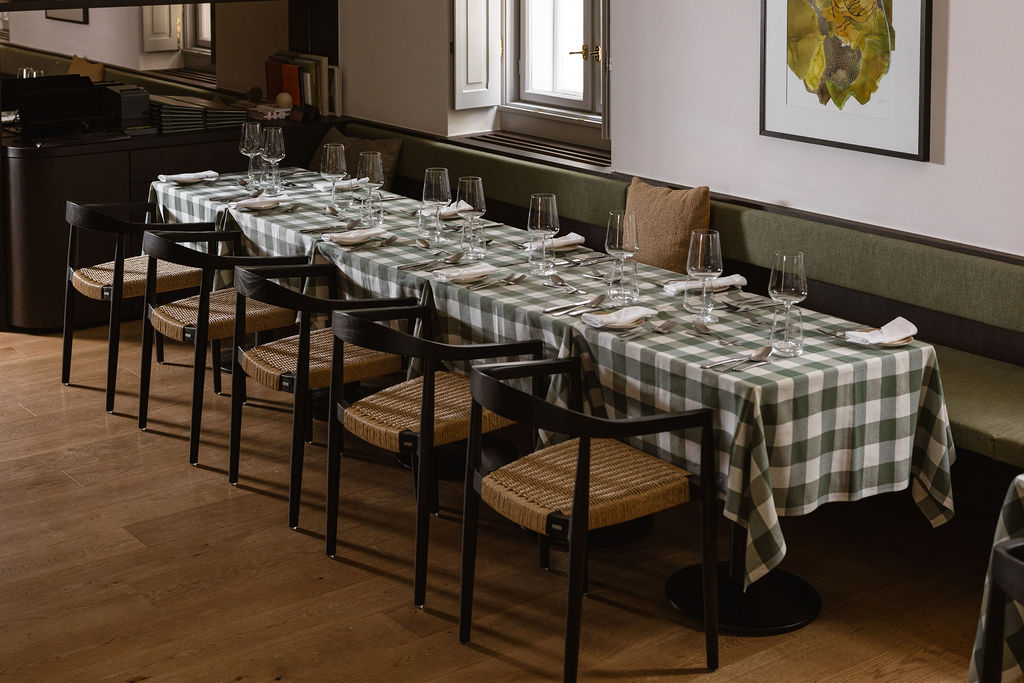
A glass of wine, a table, a story.
Galuschka Bistro & Garden · Tokaj
Many cellars from old Tokaj have survived. But the history of the wine region was not only written underground and among the vineyards. It is also present in the old inns, at café tables, and in the stories of former guests. Who sat across from each other, what they talked about, and where deals were made, we now mostly learn from old papers.
Perhaps that is why it is still worth reserving a place in a Tokaj inn today. Because a glass of wine and a well-prepared meal can speak not only of the present but also of the city whose history is present in every street, every old building, and every passed-down story.